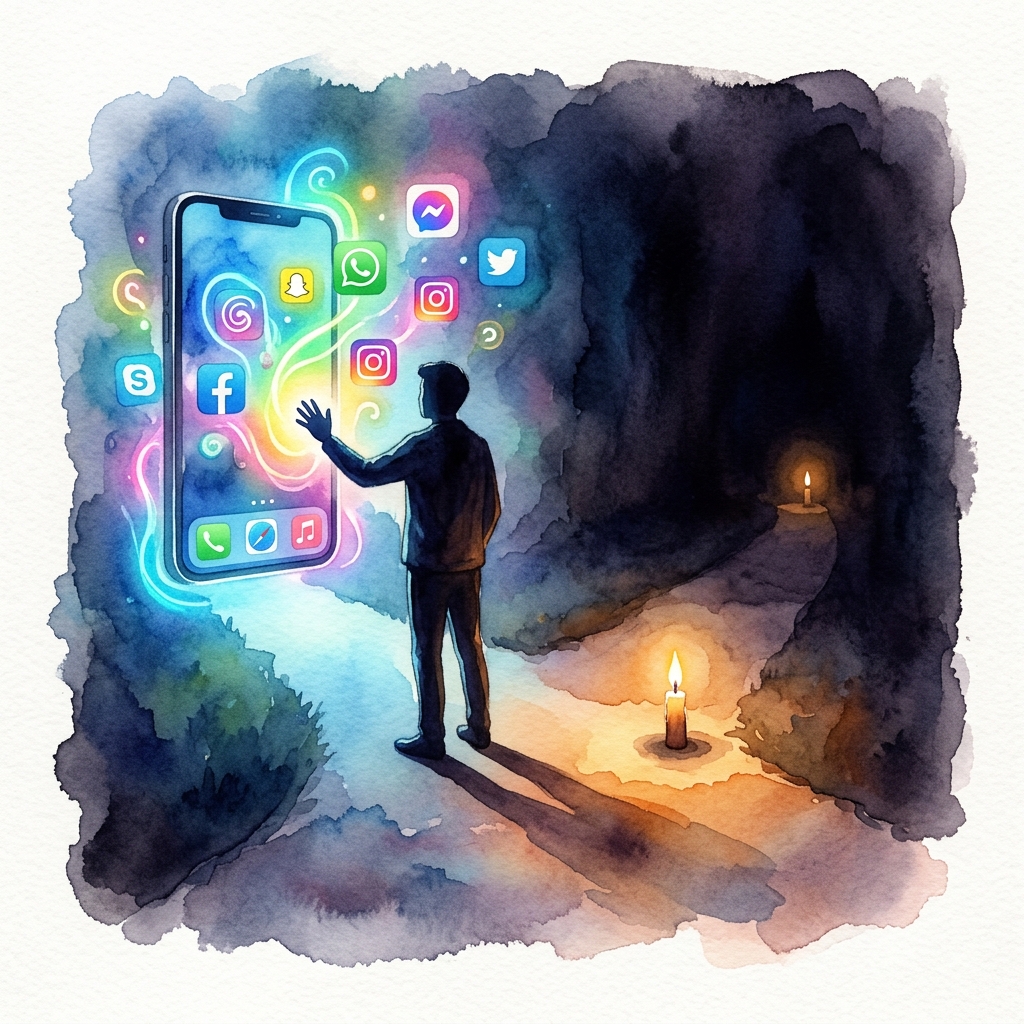
The moment of choice never arrives. The choice has already been made.
Essay · Psychology
The Matrix Is Already
Happening
On people who avoid eye contact, the cost-free escape,
and a world where the Blue Pill is supplied without limit
Chapter One
People Who Avoid Eye Contact
You pass someone in the hallway. Their gaze dips slightly downward. It isn't just a lowered head — it's an act of avoidance. That small gesture carries more information than you might expect.
At first it reads as simple timidity. An introverted personality, social anxiety, or just the way some people are. But look more closely and you'll find something else. Even shy people hold eye contact sometimes — when they feel safe, when the relationship is comfortable.
"The problem isn't imperfection. It's that they know, deep down, they haven't given their honest best — and something in them wants to keep that hidden."
Knowing you fall short. Avoiding the gaze that might remind you of it. This is a defense mechanism operating on autopilot. You don't consciously choose it. It simply happens.
Chapter Two
When Defense Becomes Habit
Defense mechanisms are useful, originally. They are psychological devices that shield us from emotions too overwhelming to bear. Someone with trauma avoiding related triggers is closer to a survival instinct than a character flaw. The problem is when this becomes habitual.
Awareness of inadequacy → Discomfort arises → Avoid the trigger that recalls it → Temporary relief → Inadequacy remains → Repeat
The more the loop runs, the wider the radius of avoidance. At first you only dodge that person's eyes. Then you avoid the spaces where they appear. Eventually, you flee everything that might recall the feeling itself.
What makes this more serious is that the loop runs without self-awareness. There is no recognition that "I am avoiding an uncomfortable emotion right now." You simply pick up your phone. Open YouTube. Start scrolling.
· · ·
Modern society has made this avoidance extraordinarily easy. That is the real problem.
Chapter Three
The Physical Cost of Escape
Has Converged to Zero
People have always escaped. Uncomfortable feelings, realities they didn't want to confront, people they didn't want to face. There were always ways to avoid these things. But every method came with a cost.
Figure 01
The Evolution of Escape — How the Physical Cost Has Changed
Escape Methods of the Past
- Go to a bar (travel + money)
- Take a trip (time + expense)
- Sleep (requires actual exhaustion)
- Go to the gym (energy expenditure)
Escape Methods Today
- Pick up your phone (0 sec, $0)
- Open YouTube (0 sec, $0)
- Scroll social media (0 sec, $0)
- Watch Shorts (0 sec, $0)
Escape in the past was always "movement within reality." Now you can leave reality without leaving it.
This is not merely a matter of convenience. When the cost converges to zero, it means the last mechanism that used to restrain escape has disappeared.
Chapter Four
Avoidance and Suppression
Are Not the Same
The person who goes to a bar knows they are uncomfortable. They know they are running away from it. The next morning, the feeling returns. And at some point, an opportunity to confront it will arrive.
But algorithmically engineered digital stimulation works differently. The moment an uncomfortable feeling rises, a stronger and more immediate sensation buries it beneath the surface.
Avoidance: Knowing the feeling is there, but stepping away from it temporarily
Suppression: Using a stronger stimulus to render the feeling unrecognizable
The brain is captured by the stronger stimulus. The relatively weaker signal — the quiet, uncomfortable inner feeling — is ignored. It drops below the threshold of perception. It is treated as if it doesn't exist.
"The uncomfortable feeling didn't disappear. It became invisible under a stronger stimulus."
This distinction is critical. A suppressed feeling accumulates without being processed. And it increasingly demands the opportunity to be confronted. The trouble is, that opportunity is given less and less often.
Chapter Five
The Blue Pill Is Being
Supplied in Infinite Quantities
In the film The Matrix, Morpheus presents a choice. Take the Red Pill and you see the truth. Take the Blue Pill and you live in blissful ignorance. In the film, Neo chooses.
In reality, it's different. Neo is never even given the chance to choose the Red Pill.
Figure 02
The Digital Matrix Loop — Why Confrontation Never Happens
Sense of
Inadequacy
A feeling of where you stand
Discomfort
Arises
A quiet inner signal
Stimulus
Covers It
Delivered instantly by algorithm
Forget
Reset
Cleared without confrontation
This loop never leads to confrontation → processing → growth. The Blue Pill is being supplied continuously.
Robbed of Quiet Moments
Confrontation doesn't happen through special effort. It happens naturally when a quiet moment arrives. When you sit still doing nothing, when you shower, when you're walking and a thought drifts through. That's when the uncomfortable feeling surfaces, and in watching it, you realize something.
The current environment doesn't permit those quiet moments to exist at all. The three minutes waiting for the bus, the thirty seconds in the elevator, the time spent eating, the moments before you fall asleep — every gap is filled. Automatically, habitually.
"The Matrix was never science fiction. It's already here. And recognizing that — that itself is the first effect of the Red Pill."
The most unsettling part is this: the system is not malicious. It is simply optimized for human weakness. A platform designed to generate revenue the longer you stay, the more you click. And that design fits perfectly with our instinct to avoid.
The smartphone = a Blue Pill vending machine. Infinite refills, free, 24 hours a day. A structure that willpower cannot overcome.
Every Monday morning, Jihun told himself this week would be different. He knew the direction of the project proposal was off. He could say something to his team lead, or at least sit down and think it through on his own. He had a sense that something needed to happen.
That sense rises on the subway to work. It doesn't last five minutes.
"Anyway, there are so many meetings this week. There's no time to focus."
He mutters that to himself and opens YouTube. A video he'd left half-finished yesterday. The algorithm threads the next one in. By the time he reaches the office, the uncomfortable feeling is gone. More precisely — it's been buried.
After lunch, there's a moment when his mind goes blank. It surfaces again. It takes less than ten seconds to reach for his phone.
Friday evening on the commute home. The proposal is untouched. Jihun can't quite identify where that feeling comes from. He just feels tired.
"Only when you know what you're avoiding can you finally begin to face it."
Suyeon happened to check her screen time. Six hours and twenty-eight minutes per day on average. At first she couldn't believe it. No way. But numbers don't lie.
That was the first time she asked herself: what am I trying to avoid?
"Honestly, I was afraid of doing nothing. When I just sat still, strange thoughts started coming up."
That's what she told a friend. Strange thoughts — though they weren't strange at all. Things like what she actually wanted, whether she was heading in the right direction. Uncomfortable thoughts, but important ones.
Suyeon ran an experiment. Thirty minutes each morning with no phone. The first two days were uncomfortable. Her hands felt empty, like something was missing. On the third day, things started surfacing in that open time.
Everything that surfaced was uncomfortable. She faced it anyway. That was the beginning.
"Thirty quiet minutes resolved more than six hours of digital escape ever could."
Chapter Six
How to Choose the Red Pill
Choosing the Red Pill is not dramatic. It doesn't mean cutting off your phone forever, or rejecting the digital world entirely. It comes down to one thing: deliberately creating quiet moments.
Figure 03
The Loop Where Confrontation Happens
Quiet
Moment
Intentionally created empty time
Feeling
Surfaces
Uncomfortable but real
Confront
Process
Watch it. Name it.
Growth
Change
Even something small
To run this loop, only one condition is needed — a quiet moment.
A quiet moment doesn't require a meditation cushion. Take out your earphones while walking. Flip your phone face-down during a meal. Spend five minutes before sleep just staring at the ceiling. Something will surface in those gaps.
So — what are you
avoiding right now?
Avoiding eye contact isn't only something other people do. That person could be you, and you could be that person. Knowing you fall short of something, quietly and automatically fleeing everything that might remind you of it. The modern digital environment has made that avoidance extraordinarily easy — and extraordinarily complete.
The Blue Pill is supplied automatically, without you ever choosing it. Every moment, in your hand, for free. The Red Pill must be chosen. The choice to put the phone down when discomfort rises. The choice to sit with silence. The choice to watch what comes up.
"An emotion you haven't confronted doesn't disappear. It simply comes back louder the next time."
Right now, having finished this piece — what will you do? Move on to the next piece of content? Or set your phone down for a moment and look at whatever is rising in you?
That choice is the Red Pill.
— hian, March 2026