Shoshin (初心)
How to Learn Infinitely
with Beginner's Mind
The real reason learning slows as we age
and the one key that reverses it
What Blocks Us
from Learning Forever
Have you ever watched a two-year-old navigate a smartphone with effortless confidence? The child reads no manual. When something goes wrong, there are no tears. She simply taps, swipes, and taps again. There is no fear.
Most adults, by contrast, install a new app and immediately loop through: "Am I doing this right? What if I get it wrong?" It's not that the brain has changed. The mindset has.
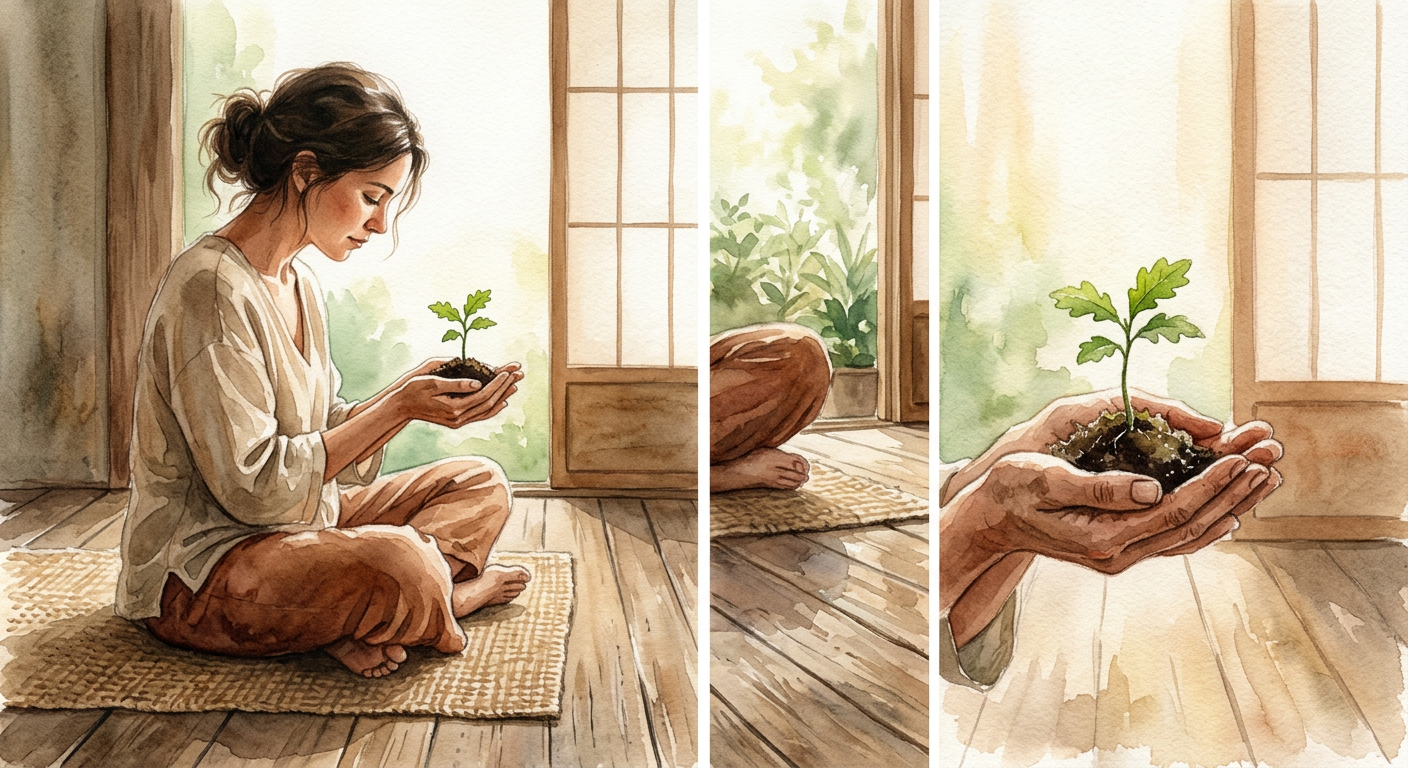
A concept discovered by Japanese Zen monks eight hundred years ago and now being rediscovered by modern neuroscientists. Shoshin — beginner's mind — is the quality of approaching something with no preconceptions, no pride to protect, and pure, unfiltered curiosity.
"In the beginner's mind there are many possibilities,
— Shunryu Suzuki
but in the expert's mind there are few."
Consuming Information
Is Not the Same as Learning
Junhyuk was doing well by every visible measure. He made team lead at thirty-two. The salary kept climbing. Whenever someone said "looks like things are going great," he'd nod along. Then one morning, before he was fully awake, a thought arrived without warning.
"What exactly am I doing with my life?"
He'd read the leadership books and sat through the product strategy courses. He was consuming plenty — yet nothing seemed to accumulate. One Sunday, an algorithm-served video began playing almost by accident.
The video said: "Consuming information and actually learning are not the same thing. Consumption gives you the feeling of understanding. Learning is when you yourself change." Junhyuk realized he had spent years mistaking the feeling of understanding for genuine growth. He had never really risked being wrong. Only risk-free input had been piling up, while the discomfort of real learning was quietly being avoided.
The Ability to Turn Off
Autocomplete
The brain loves efficiency. Once a pattern is learned, it runs on autopilot. Even when encountering something genuinely new, the brain tries to map it onto something already known: "Oh, this is basically that thing I did before." And in doing so, it misses the actual structure of what's in front of it.
Shoshin is the ability to turn that autocomplete off. Even when something feels familiar, to approach it as if seeing it for the very first time, with no assumptions layered over it. Junhyuk described it like this.
"I'm not a team lead right now. Sitting in front of this screen, I'm nothing but a new hire on day one."
In that moment, he said, curiosity rushed in where fear had been. Neuroscientist Dr. Andrew Huberman describes the conditions under which the brain's plasticity activates: focused attention, genuine willingness to make mistakes, and actively pushing yourself into unfamiliar territory. Shoshin satisfies every one of those conditions.
Radical humility — "I don't know yet."
Absolute confidence — "Even so, I will figure it out."
Humility opens the door to learning. Confidence keeps you walking through it.
Why Experts
Get Trapped
Here is the irony: the harder you've worked to learn something, the harder new learning becomes. A developer with ten years of experience will often struggle more to pick up a new language than someone starting from absolute zero. The more you know, the more the new gets pulled into the gravitational field of the old.
Psychologist Abraham Maslow put it plainly: "If all you have is a hammer, everything looks like a nail." An expert's knowledge is both a powerful lens and a powerful filter. The lens lets you see more. The filter prevents you from seeing at all.
In product strategy meetings, Junhyuk had been repeating the same loop for years. Whenever a junior colleague raised a new idea, the first thing to move in his mind was always this: 'There's a reason we never did that.'
Remembering that reason matters. But the moment memory starts blocking inquiry, expertise becomes the enemy of growth. Shoshin is the capacity to notice exactly that moment.
"The longer you've known something, the harder — and more necessary — it becomes to pretend you don't."
— hian
The Brain
Loves Confusion
You've probably heard the word neuroplasticity — the brain's ability to build new connections and rewrite existing ones. For a long time, scientists assumed this capacity was active only in early childhood. The adult brain, they believed, was fixed.
They were wrong. The brain keeps changing until the day it stops. But only under certain conditions: you need deep focus, and you need to be genuinely confused. When you feel like you already understand something, the brain doesn't bother building new circuits. That sense of not knowing — the discomfort of it — is the fuel that drives growth.
① Focus — circuits don't strengthen when the mind is scattered
② Confusion — you must stay with what isn't yet understood
③ Repetition — the same stimulus repeated solidifies the path
Shoshin naturally satisfies all three. When you approach something as though it's the first time, you allow the brain to be confused again. New circuits grow inside that confusion. People who learn quickly well into adulthood tend to share one trait: they are not afraid of not knowing. They have learned to be comfortable in that state.
Three Ways to Switch On
Shoshin in Daily Life
A mindset is trained through action. Wanting shoshin isn't enough to produce it. Specific behaviors create the conditions for it to arise.
When you encounter something new, resist the pull to search or look up the answer immediately. Spend five minutes writing: "What do I actually not know about this?" Mapping your own ignorance before you learn causes information to embed far more deeply.
Try explaining something you assumed you understood to someone encountering it for the first time. You'll find, almost every time, that certain parts simply won't come out. Those are the genuine gaps. Shoshin is the eye that sees those gaps.
Throughout your day, catch the moments when "Oh, I know this" surfaces. Those are precisely the moments autocomplete kicks in. Pause for one beat, and ask yourself whether you truly know it. That small pause is what sustains shoshin.
Junhyuk,
Six Months Later
Half a year passed. On Junhyuk's desk there is now a small card. Four words, written by hand. I don't know yet.
It felt strange at first. Wasn't it odd for a team lead to have something like that on his desk? Then one day a junior colleague looked at the card and asked, "Why do you keep that up there?" Junhyuk smiled. "To keep remembering."
In meetings, when someone brings a new idea, his first instinct has changed. Instead of "why this won't work," what arrives first is "how this might." It isn't a total transformation. Autocomplete still runs. But now he notices it. And noticing it turns out to be enough to make a difference.
Has his rate of learning sped up? Something more important than that has happened. New things no longer feel threatening. Not knowing no longer feels like something to be ashamed of. And that — he now understands — is the real condition for being someone who never stops learning.
"It wasn't that my learning had slowed.
— Junhyuk
It was that I had become afraid to learn."
Starting from This Moment
Shoshin doesn't require a crisis to begin. No special trigger is needed. Simply — right now, in this moment — treat everything as if it's the first time.
Can you look at the thing you know best in the world today, and see it again with completely fresh eyes?
Becoming an expert is inevitable. But whether that expertise becomes a prison that stops you from learning, or a platform from which you explore ever more deeply — that comes down to whether you choose shoshin, moment by moment.
In the beginner's mind there are no limits.
Only infinite possibility.
What Japanese monks discovered eight centuries ago, modern neuroscientists have now confirmed. And what Junhyuk came to feel through a single handwritten card on his desk.
Learning doesn't slow because of age. It slows because we've grown comfortable pretending to know.
I don't know yet. That one sentence switches your brain back on.