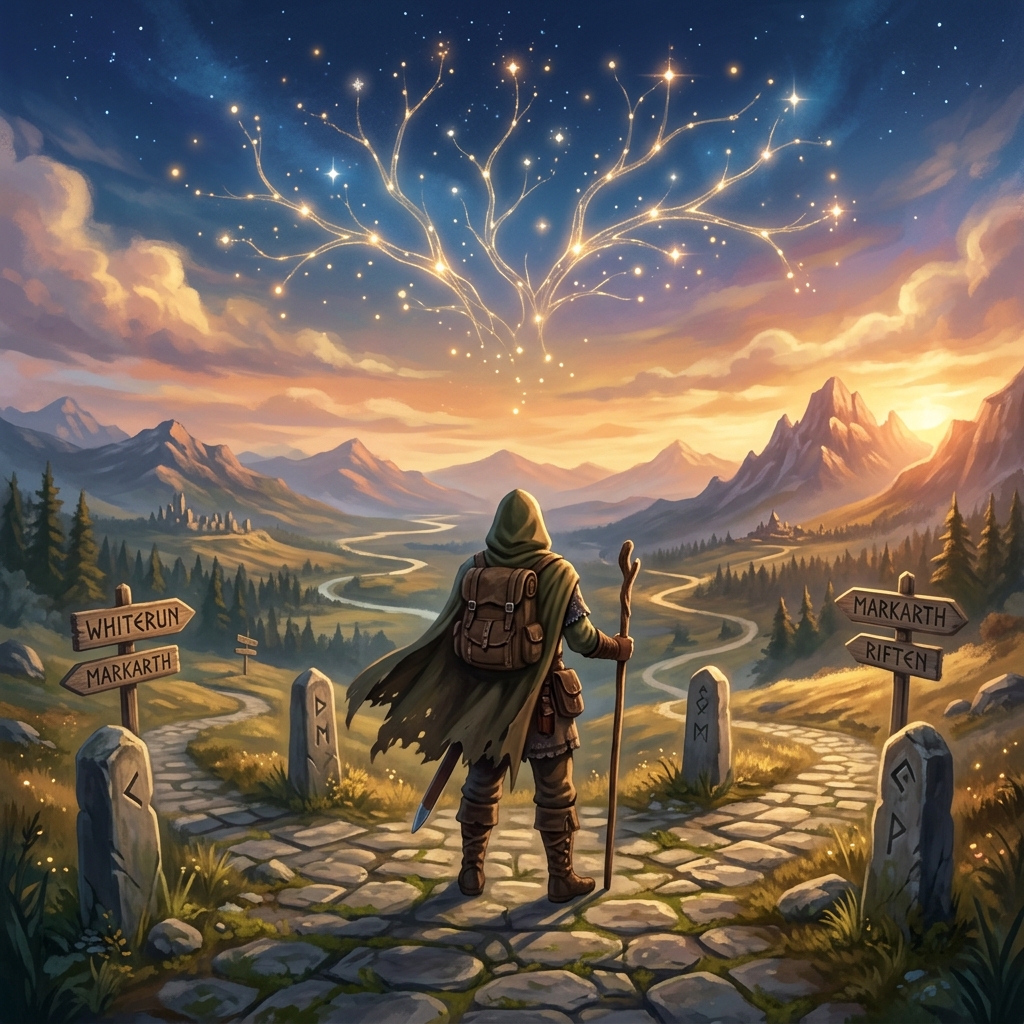
How to Allocate Skill Points in the Game Called Real Life
Essay · Life
How to Allocate Skill Points
in the Game Called Real Life
Running without direction is foolish.
Staying at the starting line in endless prep mode is, too.
Both extremes are wrong.
Chapter One
Real Life Is a Game
At first, the question felt weightless. Is real life a game? It seemed a little too cute for a metaphor — too loose to take seriously. So most people let it pass.
But the longer you sit with it, the more you realize it's not a metaphor at all. Games have rules, levels, and skills. So does real life. The more you practice something, the more proficient you become. Experience accumulates. Once you learn something, it stays in your body. The structure is too similar to ignore.
Real life is a game. So what should we do? The answer is simple — play the game. Level up, invest in skills, and move toward whatever you're ultimately trying to reach.
The problem isn't whether you play. It's how. Just as two players in the same game can end up with completely different outcomes, the way you allocate your skill points changes everything.
Chapter Two
Two Wrong Ways to Play
1. The Player Running Without Direction
Some people allocate skill points without thinking. They move on the belief that doing something — anything — will eventually pay off. They build credentials, earn certifications, study English, pick up coding. All good skills. The problem is they have no idea where any of it is pointing. One day they look back and find the build is off. They worked hard — and somehow ended up somewhere they never intended to be.
"I clearly tried. So why am I standing here?"
2. The Player Frozen at the Starting Line
On the other end, there's the person who overthinks everything. They spend so long trying to perfect the skill tree in their head that nothing ever gets allocated. Is this the right skill? Would that direction be better? What if I need to reset later? The deeper the thinking, the further action recedes — and in the end, all that caution becomes just another form of stillness.
Jihun stayed busy through his entire twenties. TOEIC 900, an IT certification, Excel courses, self-taught Photoshop, real estate seminars, a YouTube channel. If something was considered valuable, he tried it. He figured something would come of it. That felt like effort.
At thirty, while putting together a resume for a job search, a strange feeling crept in. He had a lot of skills — but he had no idea what he wanted to do with any of them. His skill tree branched in every direction. There was no center.
"What am I actually good at? No — what do I actually want to do?"
The problem with running without direction is that you will always, eventually, run into that question. And when you do, the first emotion tends to be hollow — a quiet, disorienting kind of defeat. I tried so hard. How is this where I ended up?
"It was never a skill problem. It was a direction problem."
Chapter Three
How the Smart Player Does It
So what's the right approach? The answer lies somewhere between the two mistakes — running blindly and endless preparation. It comes down to three words: research, insight, and commit.
· · ·
First, research. Understand what game you're actually playing, and which skills can get you to where you want to go. Study the structure. No matter how hard you run, if you're following the wrong map, you'll arrive at the wrong place. Research feels slow — but in hindsight, it's always the fastest route.
Next comes insight. Gathering information and truly seeing through it are different things. Real insight arrives the moment scattered dots connect into a single line. When that line finally appears, the skill tree starts to draw itself in your mind.
Once the picture is clear, you have to be decisive. Hesitation at that point is a luxury you can't afford. Allocate the points. Learn. Move. Closing the gap between thought and action as quickly as possible — that is the smartest way to play this game.
Chapter Four
Why Real Life Is Better
Than Any Game
Here's where things get interesting. In a typical RPG, mis-allocating skill points comes with a price. You reset. You start over. That's exactly why players become so cautious, overthink every choice, and end up allocating nothing at all.
Real life is different. Here, no skill you ever learned goes to waste. No experience, no mistake, no detour ever fully disappears. They resurface in other contexts, in unexpected ways, at unexpected times. Things that seemed completely unrelated suddenly fuse into one powerful, singular ability.
You don't need to stop and mourn a past decision. Mis-allocating a skill point doesn't end this game. There's only one real game over here.
"Losing the will to grow. That is the only true game over."
What Will You Allocate Next?
If real life is a game, then right now — this moment — you're already playing. Whether you're sitting in front of a screen, on the subway to work, or replaying yesterday's regrets — the game does not pause.
You don't need to see the final boss yet. You don't need the whole skill tree mapped out. You just need to think about what skill you can invest in right now, and what choice you can make today. As long as that attitude stays alive, it doesn't matter which route you took — you'll find your way to where you actually want to be.
Research wisely. Execute boldly. And keep moving.
This game isn't over yet.
What skill do you want to allocate next?
— hian