Why Are Humans
Smarter Than
Other Animals?
From climate change to civilization: the chain reaction through which intelligence evolved
The Starting Point
Bipedalism, a large brain, civilization. We take these outcomes for granted. But why did it happen to Homo sapiens, of all species?
Two and a half million years ago, several kinds of humans walked the earth. Neanderthals, Denisovans, Homo erectus, Homo floresiensis. Of all of them, only one species survived: sapiens. The feeling that "we" were the inevitable result is nothing more than the perspective of the side that made it through.
People often say it was because of our larger brains. But that is closer to stating the outcome as though it were the cause. Neanderthals, in fact, had larger brains than we do. The brain did not grow on its own, nor did brain size alone produce civilization.
Human intelligence is not the product of a single cause. It is a chain reaction — one in which many pressures reinforced one another over millions of years.
Standing on Two Feet
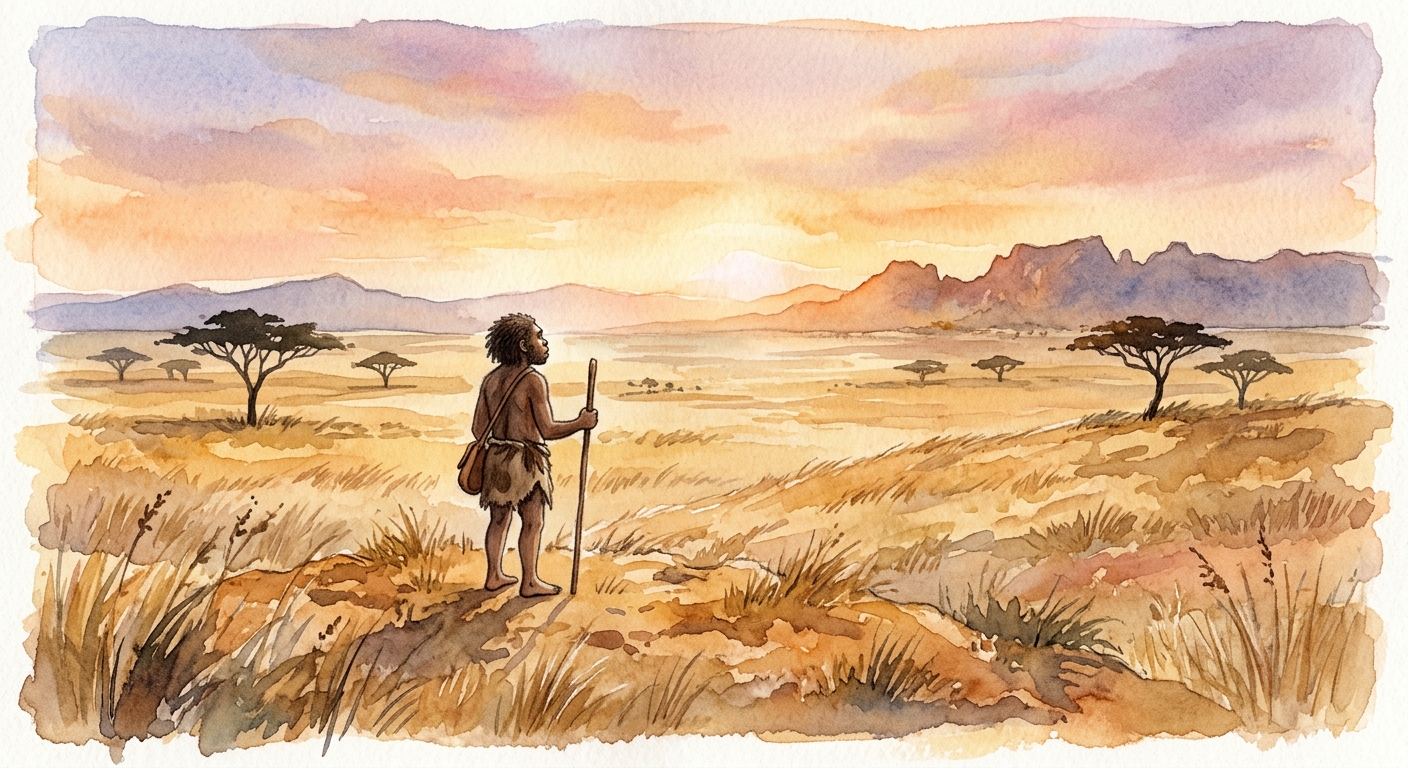
Around six to seven million years ago, the African climate shifted rapidly toward aridity. Dense forests gave way to sparse savanna, and ancestors who had plucked fruit from the trees could no longer live as they once had.
As the distances between trees grew, finding food meant descending to the ground and walking long distances. The open grassland offered little cover; predators could spot you easily. The midday sun was merciless. Under this pressure, individuals who happened to stand upright survived, little by little, more often than those who did not.
What looked like an unstable posture turned out to carry a surprising number of advantages all at once. It required less energy, opened up a wider field of vision, and reduced the body surface exposed to direct sunlight. And above all, it freed the two forelimbs from the task of locomotion.
Environmental change forces a choice. Walking upright was not a romantic aspiration — it was a compromise imposed by the conditions of the savanna.
Why Two Legs Beat Four
The advantages of bipedalism were not singular. It was a rare solution that paid dividends across four separate dimensions simultaneously.
Of these, the most far-reaching consequence was the hand. It could grip and carry tools, transport food across long distances, and hold an infant while walking. Everything that came after was built by that hand.
The Pelvic Dilemma
But there was a price to pay. To sustain upright posture, the pelvis had to become narrower and more rigid — otherwise the body weight would collapse inward between the two legs.
At precisely the same time, the brain was growing larger. A narrowing birth canal and an expanding skull: at the point where these two forces collided head-on, evolution settled on one compromise. Give birth before the fetus is fully developed. Send the infant into the world in an unfinished state.
Childbirth became more dangerous than in any other species, and the newborn more helpless than any other animal's young. The "pain in childbearing" written in Genesis is not a divine curse — it is the price of standing upright.
A foal runs within hours of birth. A human infant takes more than a year to walk.
Vulnerability Demanded Society
A child born too early cannot survive alone. It must be held for a long time, fed for a long time, taught for a long time. This was more than any two parents could manage.
Everyone was needed. Grandmothers were needed. Neighbors were needed. "It takes a village to raise a child" is not a metaphor — it is an evolutionary fact. Without a group raising the young together, there was no next generation.
And that long period of dependence turned out to be an unexpected gift. While a chimpanzee infant becomes independent within a few months, a human child spends more than a decade at an adult's side. That time became the channel through which language, story, knowledge, and skill crossed from one generation to the next. Humans became the first animals capable of storing memory outside of DNA.
Vulnerability compelled society; society expanded the brain.
How the Brain Grew
The brain did not grow under a single pressure. Four forces interlocked, each pushing the others upward.
The brain accounts for just 2–3% of body weight, yet consumes roughly 25% of the body's resting energy. Without all four pressures operating simultaneously, it would have been an unaffordable luxury.
The Fragile Middle-Rung
There is a fact that is easy to misunderstand. Humans did not start at the top of the food chain. For the vast majority of two million years, the ancestors of sapiens occupied an awkward middle position.
A lion would bring down a wildebeest; hyenas would tear at the carcass; only then could early humans approach and scrape out the marrow from the bones. A scavenger that hid from predators. Until only a few hundred thousand years ago, that was the creature humans most resembled.
Then, within a mere tens of thousands of years, humans vaulted to the apex of predation — claiming a position that other animals had climbed to over millions of years, accomplished in what amounts to a heartbeat. This sudden ascent is the backbone of human history.
The ecosystem had no time to prepare for this overnight rise. And within us, the anxiety of the savanna still remains.
The Cognitive Revolution
The trigger for that leap was pulled somewhere around seventy thousand years ago. The structure of language changed in a fundamental way. Yuval Noah Harari calls this event the Cognitive Revolution.
Before it, language was primarily a system of warnings. "Lion!" "Snake!" The next stage was gossip: who was associating with whom, who was being deceptive. This chatter seems trivial, but it was in fact the glue that held ever-larger groups together.
Then the decisive leap occurred. Humans began to speak about things that were not immediately present — and about things that had never existed at all. The spirit of the river. The guardian deity of the tribe. The promise of an ancestor. The capacity to fabricate fiction.
A monkey can warn that a lion is near. Only a sapiens can declare that the lion is a god.
The Ability to See the Invisible
At the root of the capacity for fiction lies a more fundamental engine: causal reasoning — the ability to extract a principle from what has been observed, and then use that principle to predict what has not yet been seen.
Animals recognize patterns too. A crow reads the colors of traffic lights; a dog anticipates a walk at the sight of its owner's bag. But that is as far as it goes. Once the visible cue disappears, the inference disappears with it.
Humans are different. We do not stop at "when it rains, the fruit is plentiful." We leap further: "then there must be water in that valley over there right now." Observation → principle → prediction of phenomena not yet witnessed. This three-step jump is the foundation of sapiens' advantage.
Causal reasoning maps where the next prey will be found in the hunt, reads the intentions of others within the group, and — inside the mind — conjures the image of a god who has never existed.
The Imagined Order
When causal reasoning — once a solitary act — began running simultaneously inside many minds at once, the real explosion took place. Large numbers of people who shared the same fiction could cooperate even without ever having met.
God, the nation-state, law, money, the corporation. These five things are invisible. They cannot be touched. And yet the moment everyone believes they exist, they become a genuine force. Harari called this the imagined order.
The stable upper limit of a chimpanzee group is around 150 individuals (Dunbar's number). Sapiens, simply by sharing the same story, can coordinate hundreds of millions.
The ceiling of the ecosystem was group size. Fiction punched through that ceiling. Civilization poured out through the hole.
Returning to the Beginning
Let us return to the opening question: why are humans more intelligent than other animals? By now we know it cannot be answered in a single sentence. It was not one cause but four leaps, each propelling the next.
What a Fragile Species Left Behind
From the moment the climate began to dry out Africa's forests, to the civilization that would come far in the future — between the two lay a series of small pressures, each reinforcing the last. Remove any single one of them, and sapiens would not be here.
At the end of that long chain, one thing remains: the capacity to draw a principle from observation, and to believe collectively in something that does not exist. The ability we use every day is a tool that took millions of years to make.
Among the orders you take for granted today — which ones are, in truth, a fiction someone once invented?