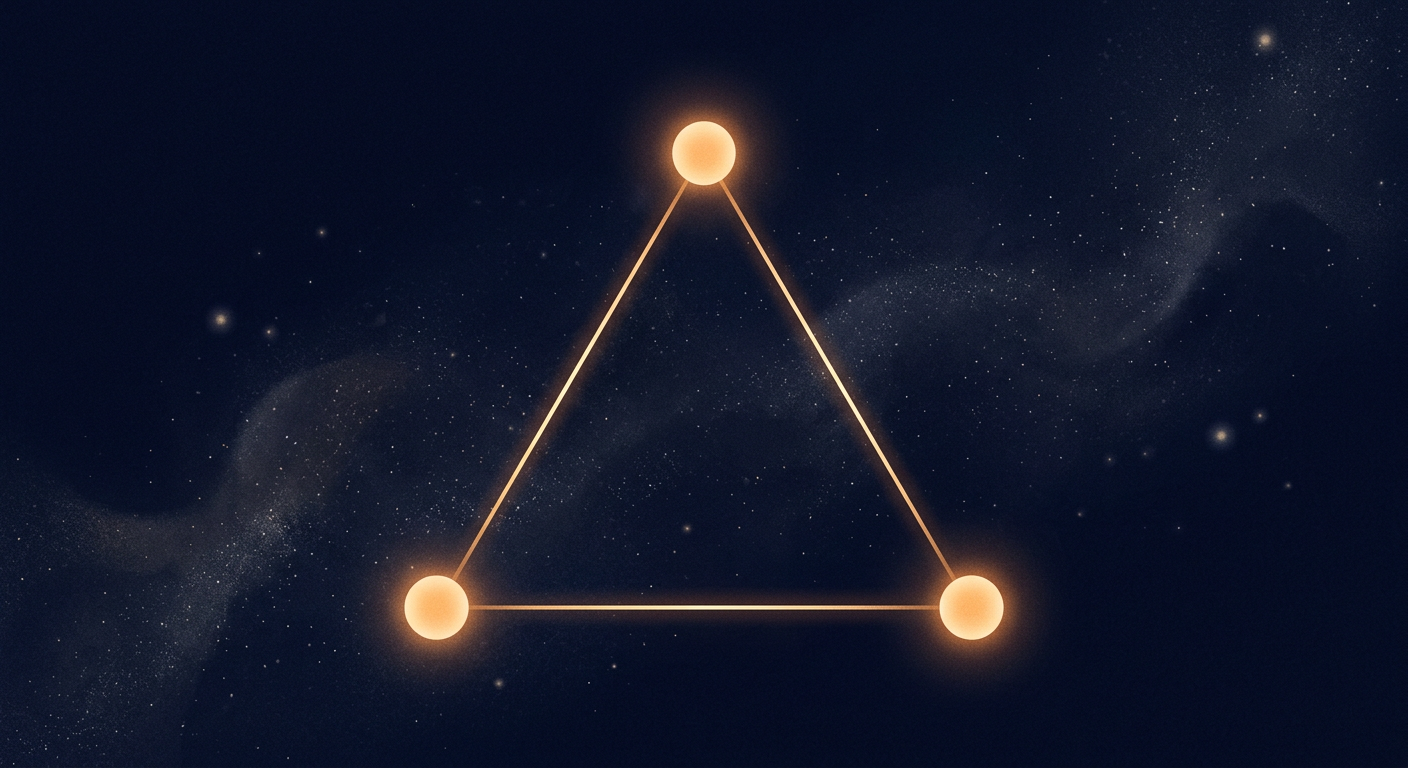
The Principle of Three
Mathematics, nature, psychology, instinct — an exploration of
why the number three keeps appearing across every domain.
Three is not a special number. The universe is simply lazy,
and that is why three keeps showing up.
Why Three Is Special
Three is everywhere. Mathematics, nature, music, religion, storytelling. But the real question is a different one entirely. Why?
A triangle has three vertices and is structurally the most stable polygon. Three is the minimum number of points needed to define a plane in space, and the minimum number of faces needed to form a three-dimensional solid.
The brain feels most at ease when processing information in groups of three. "Three reasons" in a presentation, beginning–middle–end in a story, gold–silver–bronze. Tension always resolves when you count to three.
The Christian Trinity, Buddhism's Three Jewels (Buddha, Dharma, Sangha), the three Fates of Greek mythology. Across Eastern and Western traditions alike, sacred concepts converge on three. It is no coincidence that every language has some version of "I'll count to three."
The three-act structure, the trio of characters, the fairy-tale wish always granted three times. One is too simple; two is opposition. Only with three does a story truly begin.
"One is too simple. Two is opposition. It is only at three that a story is born."
Three is the smallest unit that creates a sense of completion. But why is this possible? There must be a deeper principle at work.
All Phenomena Converge
on a Single Principle
"Every phenomenon contains a principle. Diverse domains and experiences, if you dig deep enough, can converge on a few — or even a single — underlying law."
— hian
Seen from this angle, three is not merely a number. It is the recurring signature left behind by a deeper law.
| Domain | Triadic Structure |
|---|---|
| Physics | Space · Time · Matter / Proton · Neutron · Electron |
| Logic | Premise · Inference · Conclusion |
| Biology | DNA codons are read in triplets of three bases |
| Music | C–E–G — the triad is the foundation of harmony |
| Linguistics | Subject · Verb · Object |
No comparison
State of tension
Structure born
Three is the point at which direction finally appears. The cycle A→B→C→A comes into being, and cycles are stability. That is the essential insight.
One exists alone. Two is only tension. At three, a network of relations forms, structure is born, and circulation becomes possible.
The Minimum Structure
That Makes Stability Possible
"A principle is a rule and a pattern — a discovery of the state that can become stable beyond mere opposition. Could three be the minimum unit of that stability?"
— hian
Physics has a concept called the principle of least action. Nature always takes the path that minimizes energy expenditure. If this is the foundational law, the conclusion follows naturally.
Humans Also Seek Minimum Cost
— Just Differently
"Humans make irrational choices quite often. Doesn't that contradict the principle of least action?"
— hian, self-questioning
Nature's cost is energy. The human cost is psychological discomfort. What looks irrational from the outside is, from the perspective of the person involved, the minimum cost available.
- Seeking revenge at personal loss
- Buying expensive luxury goods
- Unable to leave a bad relationship
- Binge eating
- Psychological cost of resentment
- Cost of self-esteem anxiety
- Cost of loneliness
- Cost of emotional emptiness
Nature's cost function is objective. The human cost function is warped.
Nature has a fixed cost function. Humans can change their cost function itself. That is growth, healing, and awakening. Meditation, reading, experience — all of these are ultimately the work of resetting "what you feel is expensive."
Three in Psychology
If three is the minimum unit of stability, psychology should be full of it. And it is.
(Freud)
Mediation
Standard
With only two elements, there is conflict. Hegel's thesis–antithesis–synthesis, secure–avoidant–anxious attachment, the CBT triangle of thought–feeling–behavior. When one element is suppressed or overactivated, psychological problems arise. Trauma, depression, anxiety — at their root, all are collapses of a triadic structure.
The Comfort Zone Instinct
and the Principle of Three
"Humans have a 'comfort zone instinct' in every domain. In prehistoric times, familiarity was safety."
— hian
This instinct is a survival algorithm optimized for the Stone Age, now running as a bug in the modern world.
current state
baseline
baseline
Prehistoric era: familiarity = safety = survival → encoded in DNA.
Modern era: familiarity = safety (illusion), unfamiliarity = danger (illusion).
Result: resistance to change, bias, entrenchment of habits. And this very instinct operates as a three-stage cycle.
Cognitive dissonance follows the same pattern. New information → conflict with existing belief → distort the information or change the belief. Most people choose to distort the information. Because that is the minimum cost.
Final Synthesis
Running through all of this exploration is a single meta-principle.
"Every system seeks stability at minimum cost. And three is the minimum structure through which that stability becomes possible."
The comfort zone instinct is not a flaw in human nature. It is a survival algorithm optimized for the prehistoric era, now running as a bug in the modern world.
Yet unlike nature, humans can become aware of their own cost function — and reprogram it.
That is growth. And that is what distinguishes humans from the rest of nature.