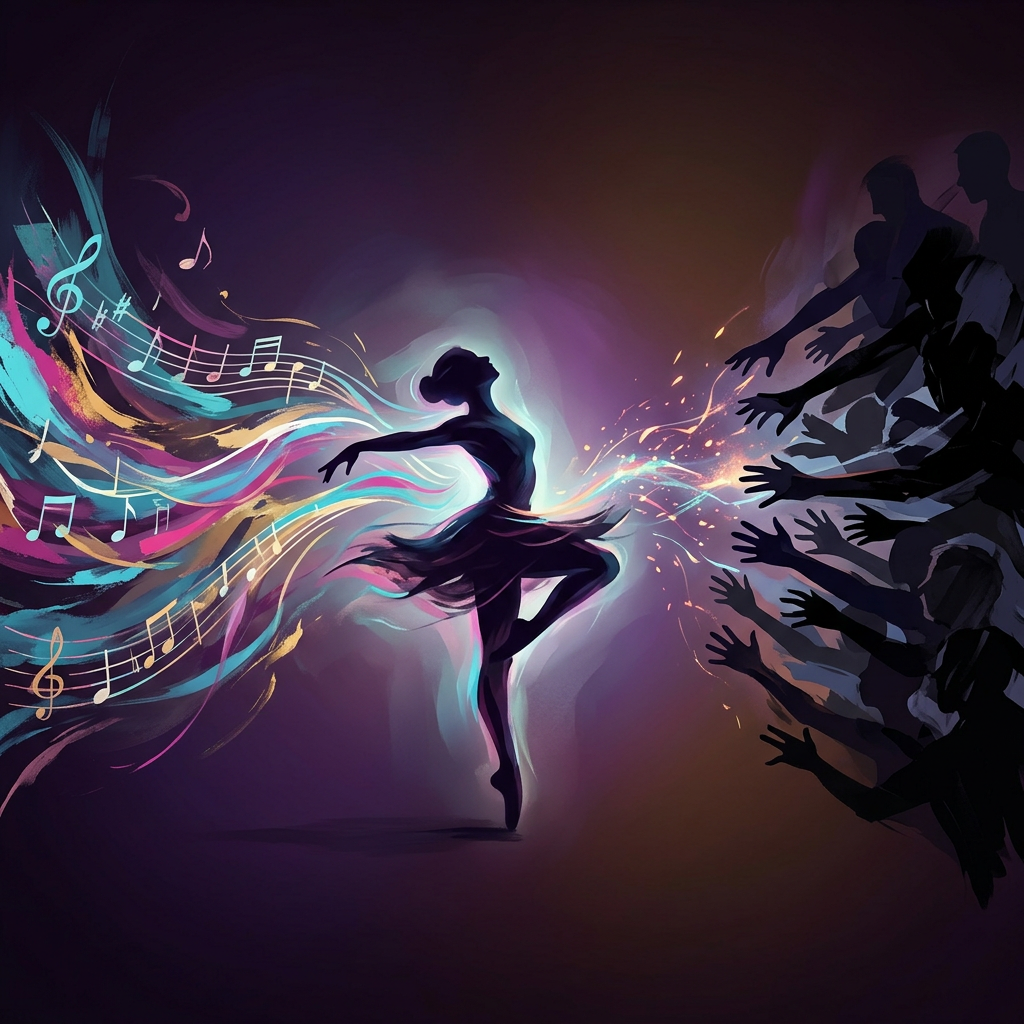
Why do artists exist?
Essay · Dance Philosophy
Why Do Artists
Exist?
Why artists exist — what an artist truly is
Receive and release. The more you empty, the more you fill.
Chapter One
Why Do Artists
Exist
In the course of living, humans are naturally trained to shut the doors of emotion. When emotion takes over, judgment clouds, mistakes multiply, and relationships leave wounds. And so the survival instinct begins early — practicing the closing of those doors.
As children, you cried when you needed to cry. You shouted when you were happy. You clung to someone when you were afraid. Then, at some point, that was no longer allowed. "Why are you crying." "You have to endure more than that." "You're an adult now."
The closed doors grow thicker with time. Live long enough like that — and you are alive, yet you no longer feel it. You eat, you work, you sleep, and one day you find yourself asking: am I living, or merely surviving?
The artist is the one who opens, on behalf of everyone, the doors of emotion that humans shut in order to survive.
Chapter One — continued
What Was Locked Away
When an audience weeps before a work of art without knowing why, it is not sadness. It is because something long locked inside — some emotion sealed away — has been opened by the artist. These are not tears of grief. They are tears of reunion. The moment of meeting again the self you had forgotten.
⟶
Survival instinct — closes the doors of emotion
↓
⟶
The artist — opens those closed doors on our behalf
↓
⟶
The audience — meets again the self they had forgotten
The reason art is necessary is simple. Because there are things humans closed off in themselves in order to go on living. Without someone to open those things on their behalf — people would live on without ever knowing what they had lost.
Minjun was thirty-six. He had spent ten years at the company, and during that time something had quietly disappeared. He couldn't name it exactly. Each day was just — similar to the last.
That evening, a colleague had pressed him into going. He had no interest in dance. He planned to sit there and wait for the time to pass.
The stage began. Music entered. The lights shifted, and someone started to move. At first Minjun watched from a distance. He could tell it was technically excellent. But then, at some point — he could no longer tell whether he was watching the stage, or the stage was watching him.
"What did it feel like?" — "...I don't know. Strangely, I couldn't breathe."
Minjun was crying. He went to the restroom to check. He was actually crying.
He didn't know why. Nothing sad had happened. It just felt — like something had burst open.
Ten years. Working, eating, sleeping through ten years. He had not cried once in all that time. Not because there had been nothing to cry about — but because he had been unable to. The person on that stage said nothing. They simply moved. And yet ten years of what Minjun had been carrying flowed out of him all at once.
The artist does not speak. They only open.
After that night, Minjun returned to performances often. Not to understand art. But to feel that feeling again — the feeling of being alive.
Chapter Two
What Is
an Artist
Most people, when emotion arrives, filter it. "Is this appropriate?" "Won't this seem strange?" "What will others think?" These filters dilute the feeling. Emotion enters, but by the time it might emerge, it has already become something else.
An artist is someone whose filter is thin, or absent altogether. Someone who simply receives what comes — the emotions of the world. And then releases them, whether through dance, music, or painting — in their own language.
Someone who receives the feelings, the life, the energy of the world with uncommon purity — and passes them on in their own tongue.
Artists are not born special. They are people who, even after passing through the process of closing, chose to open again. Or people who simply could not close.
Chapter Two — continued
The Chain of Emotion
To understand the role of the artist, you must understand how emotion moves. Emotion is not created — it is passed on.
When a composer creates a piece, they pour a feeling into it. That feeling rides the music through the air and reaches the artist. When the artist receives it with their whole body and begins to move, that emotion transfers once more — to the audience.
Information
reaches the mind
Emotion
reaches the body
Resonance
reaches the soul
The artist does not copy the original. They pass through it, and then — traveling through their own body — deliver it as something new.
Seoyeon's technique was flawless. Her professor said as much — her skill was beyond question. And yet every time a performance ended, she heard the same thing: something felt incomplete. No one could explain what.
She worked more, more precisely. She made her expressions more varied. Nothing changed.
One evening after a show, one of the audience members spoke to her.
"Your technique is wonderful — but watching you, I felt strangely lonely."
Seoyeon didn't understand. She had been moving harder than anyone on that stage.
Before the next performance, Seoyeon decided for the first time to think about nothing. Not how she would look — but what she could hear.
The music came. At first she heard the melody. Then the rhythm. Then — she felt the emotion embedded within it. Someone's loneliness. Something old. Something long endured.
Seoyeon received it. She received it and moved.
That night, for the first time, I knew I was an artist. Not because of technique — but in the moment I simply received and released.
When the stage ended, for the first time, someone in the audience was weeping. The artist is most present in the moment they disappear.
Answers to Two Questions
Receive and Release
Why do artists exist
To open, on behalf of those who have shut them in order to survive, the doors of emotion. In the moment those doors swing open — people meet again the self they had forgotten.
What is an artist
Someone who receives the emotions of the world without a filter and releases them in their own language. Someone who, in that process, erases themselves — and in doing so, becomes more fully present.
Artists are not born special. They are people who have found the courage to receive what they feel, as it truly is.
· · ·
Receive and release. The more you empty, the more you fill. The more you disappear, the more you exist.
Receive and Release
The doors of emotion that the survival instinct forced shut — the artist opens them, on our behalf. The moment you weep before art without knowing why — that is the moment you meet again the self you had long forgotten.
The artist is the one who opens those doors. Someone who chose to open again, even knowing they had been closed. Someone who, the more they erase themselves, becomes more fully present — and the more they empty, the more they are filled.
The more you empty, the more you fill. The more you disappear, the more you exist. The more you let go, the more you transmit.
When was the last time something moved inside you before art — for no reason you could name? In that moment, some door within you may have opened.