Subway Cultures
Around the World
— They Audition
Buskers in Paris?
Six countries,
six odd commutes
A certain
audition
There is one fact I learned a while ago that stayed with me longer than it had any right to. To busk inside the Paris Métro, you have to pass an official audition. I had always thought of street music as something free and unscripted, but here was a city formally handing out the right to perform on its platforms. A strangely beautiful image to sit with.
Once that bit of curiosity opened, I started wondering about other countries. The narrow car I step in and out of several times a day — how does it run differently in different places? What I found turned out to be stranger than I expected. In one city there is a profession whose job is to push people into the car. In another, your bag goes through an X-ray as if you were boarding a plane. In yet another, there are no fare gates at all. Same kind of small space, all wired so differently. Six countries, one car at a time.
The eastern
car
Start with Korea. It is too familiar to me to look like anything, but visitors say the pink light over the priority seat for pregnant women stands out the most. The seat is paired with an app over Bluetooth, so when a pregnant woman comes near it, the seat blinks pink. The intent is tender, but the actual scene reads a little differently. The seat stays empty as the train passes one stop, then another. Wi-Fi that follows you everywhere, an unspoken tolerance for the smell of a boiled egg — those are our own small textures.
Japan runs on a different grain. There really is a profession called oshiya — pushers — whose job is to cram commuters into the car during rush hour. A handful of stations still keep them on payroll. There is also something called a delay certificate. If the train runs late, the station will hand you a slip; you give it to your office and it does not count as being late. A whole society's relationship with time, compressed into one small piece of paper. Even the way Japan treats priority seating carries a different weight from Korea.
China bends the scale once more. To board, your bag goes through an X-ray as if at an airport. In some cities you cannot ride at all without a working QR-pay app, so visitors spend their first days lost. Stories of someone slurping instant noodles inside the car still drift around in travel writeups.
The western
car
Back to Paris. That audition I started with has a name — EMA, Espace Métro Accords. You pass it, and only then can you legally play music inside the Métro, which is why there is almost always a live performance somewhere down a corridor. The older cars still open by a metal handle you turn yourself. Strikes are so woven into the year that the strike calendar gets passed around like a holiday calendar. The cars themselves are full of conversation. The exact opposite of the hush of a Korean train.
New York runs on its own logic — twenty-four hours a day. There is no last train to chase, but the empty hours fill with the shadows of those with nowhere else to sleep. The air conditioning works car by car like a lottery, so in midsummer the car you board becomes the temperature of your day. "It's Showtime!" — and a dancer grabs the pole, somersaults between the seats, and moves to the next car. Lines over a hundred years old keep their age in plain view, and that age is part of the city's grain.
Germany bends in another direction. There are no fare gates at all. The philosophy that a citizen is not a suspect runs through the space itself, so buying a ticket is left to your conscience. In return, if you get caught in a random check, the fine is steep. A car for bicycles, a dog beside its owner — sights you stop noticing after a week.
Same car,
different society
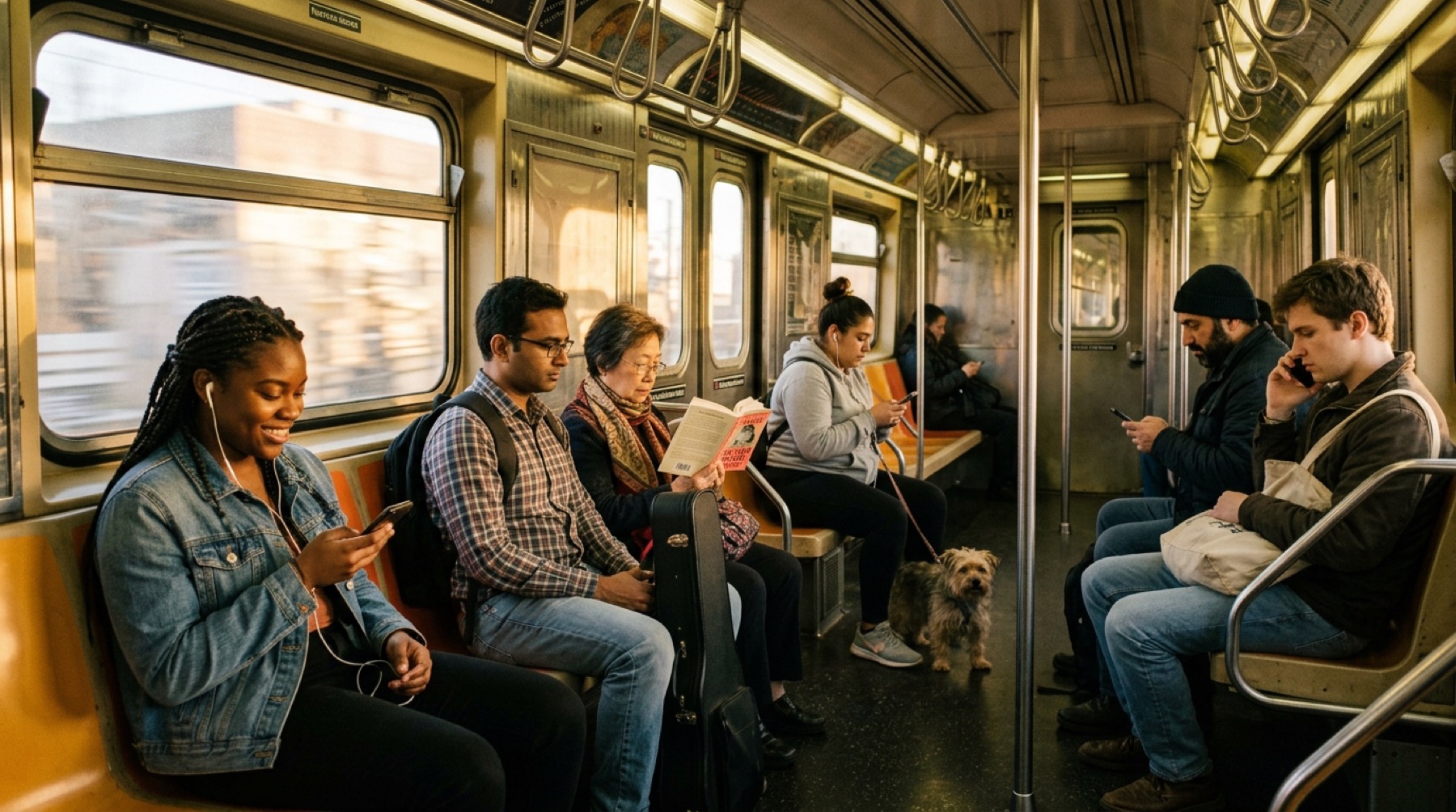
After a tour like this, one question lingers. Same narrow car everywhere — why do they all run so differently? In one city trust is built into the system itself; in another, pushing people into the car becomes a paid job. The same kind of space, with societies running across it in nearly opposite directions.
I read once that the way a society treats space is its non-verbal language. Whatever meaning a culture lays onto a stretch of distance becomes, in time, the identity of that culture. The same one meter feels like a trespass in Korea and a comfortable spacing in the United States.
It is not the distance itself that makes a culture, but the meaning a society lays onto that distance.
One subway car is the place where that meaning concentrates the most. How people sit together in a small space — almost everything about how a country handles space is already pressed into it.
The gaze
of meaning
With this gaze, look at the Korean priority seat again. That seat carries a very strong meaning: this is the place for a pregnant woman. The weight of the meaning is so clear that anyone who is not a pregnant woman hesitates even to sit there for a stop. The reason the seat stays empty is not indifference. It is the opposite. The meaning is too heavy, so the seat keeps itself empty.
Germany looks like the opposite picture, but at the grain level it is the same gesture. The space without fare gates carries the meaning of a citizen's seat. The shared promise that no one suspects anyone else has become the definition of the space, and so the system runs without the gates and without doubt.
The Japanese pusher belongs in the same family. The car carries the meaning of being on time. To keep time is the rule. The pusher, then, is not a job to be ashamed of; he is the one who helps the rule keep itself. Same act, different society — a different seat for it.
Paris bends at another angle. The Métro carries an extra layer of meaning: this is also a stage. So the audition follows naturally. The same one car becomes an empty pink seat in Korea and a stage in Paris. The shape of the space is identical; what makes the scene is the meaning laid on top of it.
Yet still
alike
And yet, one thing stands out in another way. Six countries so unlike one another, and still, one thing is the same everywhere. Wherever you go, people barely look at one another. Eyes drop into a phone. Whoever sits next to you is not received as a person. A hundred people in one car, and all hundred are alone in their own way. Korea, Paris, New York — that one part of the picture is strangely identical.
Another book put it like this. People who never meet in the eye, whose paths only cross. That, it said, is the nature of the city as a form.
We do not see one another as people with full lives — only as fellow passengers sharing the same time and place for a little while.
That is how a city dweller survives. To take in tens of thousands of strangers each day as full people would make a life impossible. So the Korean pink light, the German trust system, the Japanese pusher — each is its country's particular meaning laid as one extra layer on top of that shared passerby mode underneath.
Two
scenes
Which is why one subway car ends up showing two scenes at once.
Through the gaze of difference, each country has laid a different meaning onto the space, so behavior runs in opposite directions inside the same car. An empty seat on one side becomes a stage on another; trust here turns into time over there. Through the gaze of likeness, no matter the city, people let one another slip past in passerby mode. Both gazes live inside one small space.
So the first time you step into any car, two things read at once. What meaning has this society laid onto this seat — and on top of that, how do its city dwellers let each other drift past? One scene, with two layers running side by side.
One small
window
So next time you go anywhere, the first place to step into is already chosen. Inside one subway car, the way that country handles space is laid out for you, and at the same time, the way the city as a form keeps itself running is laid out beside it. A scene the size of a single car shows you both depths at once. One small space, and a whole society opens up inside it.
One car mirrors a society, and the city itself.