Once you see the principle, you can grow fast anywhere
Essay · Thinking
Transfer Learning
But for
Humans
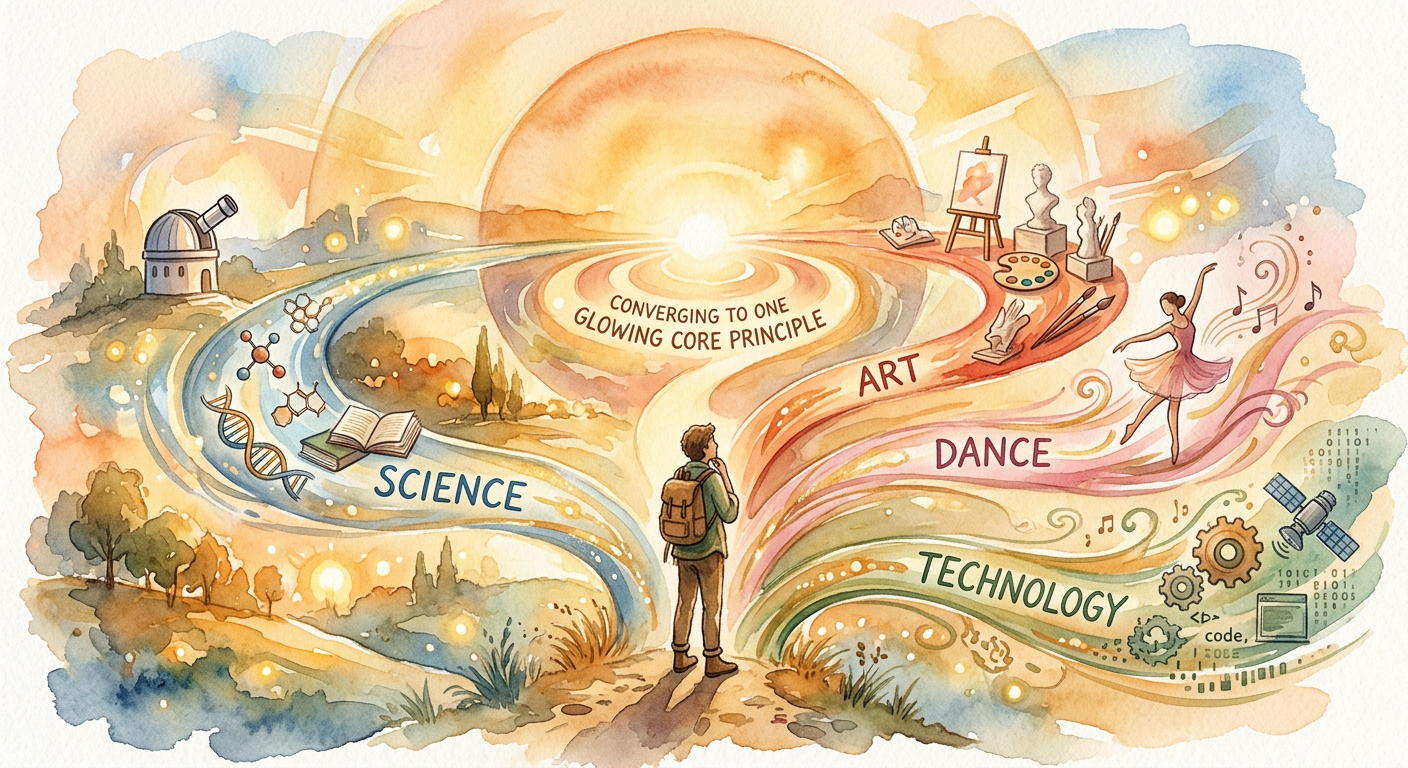
Every phenomenon has an underlying principle,
and those principles ultimately converge into one
Chapter One
What Transfer Learning Really Is
Transfer Learning is typically known as an AI concept — a pre-trained model adapting rapidly to new domains. But this same principle applies directly to human beings.
When you move through diverse domains and experiences and grasp the underlying principle, you find yourself absorbing unfamiliar things far more quickly when they share a similar structure.
This is why Elon Musk could move between rockets, electric cars, and brain-computer interfaces, building deep expertise in each. He wasn't learning fields. He was a person who learned principles.
Chapter Two
The Power and Trap of Analogy
When we explain a difficult concept, we reach for analogy. "Electricity is like water flowing through a pipe." The brain learns fundamentally through analogy, so this works — up to a point.
But here lies the trap. An analogy brings only the parts that resemble and discards everything else. Electricity-as-water lets you grasp voltage and current, but the quantum behavior of electrons becomes permanently out of reach.
The moment you feel "Ah, I get it" is the most dangerous moment. That isn't understanding — it's the feeling of familiarity.
The brain stops searching the moment it finds emotional satisfaction. Stop at the analogy, and it becomes an obstacle to genuine understanding.
Chapter Three
Analogy vs. Decomposition
First Principles Thinking begins exactly here. Learning through analogy and learning through decomposition are fundamentally different acts.
Learning by Analogy
"We did it this way before,
so let's just do it that way again."
Learning by Decomposition
"Why does this fundamentally work? What's at the very bottom?"
A principle reached through decomposition transcends domains. And one more thing — whether you can articulate that principle in words determines the speed of transfer.
Know it only in your body → transfer is limited to similar things
Able to explain it in words → transfer reaches entirely different domains
Chapter Four
The Belief That There Is Always a Cause
Pushing past analogy to reach the underlying principle requires a particular disposition: the assumption that there must be a clear cause.
Whether someone is angry, or your body won't do what you ask — if you presuppose "there is definitely a cause" for every phenomenon, the brain automatically shifts into cause-seeking mode.
People without this belief attach a label and close the search. "That's just how they are." "I'm just off today." The difference lies in how you handle not finding a cause: do you take it as "I haven't found it yet," or do you file it as "there is no cause"? That distinction determines everything.
The fact that I don't know something does not mean it doesn't exist.
Learning to dance, I got things wrong countless times. At first I made excuses. "My body is just built differently." "This move is inherently hard." I found reasonable explanations and used them to cover the discomfort.
"There's a reason the movement isn't coming out. But you don't need to know what it is yet."
That's what my teacher said. The body cannot lie. Even with excuses, the movement still didn't come.
"If you don't know, you fail. If you fail, it shows. That's all there is."
Eventually, through repetition, something shifted. Every time a movement failed to appear, I began hunting for the reason. The position of my center of gravity. The timing of my breath. Where my eyes were pointed. Find one thing, fail again, and something new would come into view.
Don't know, fail. Fail, see. See, find the cause. Cycling through this thousands of times is what built the way I think now.
Dance was never just a hobby. It was an epistemological training ground.
And I came to see that this same disposition operates identically in coding, in relationships, in any new domain I step into. The training to seek causes transfers.
Closing
People with fast Transfer Learning share one thing. They ask the same question in every domain.
"Why did this happen?"
In dance, in code, in relationships — when the question stays the same, the principle comes into view. And once the principle is visible, you can grow fast anywhere.
Not stopping at analogy. Not mistaking familiarity for understanding. Not giving up when a cause seems absent. These three things are the substance of human Transfer Learning.
If there's a field where you feel you're learning too slowly — the field may not be the problem. The question you're asking might be different.
— hian, 2026.03